EPC guides
The hidden administration behind a simple EPC booking
An EPC booking can appear to be one of the simplest parts of a property instruction. The agent provides the address, the assessor arranges a visit and the certificate is issued. In some cases, the process really is that straightforward.
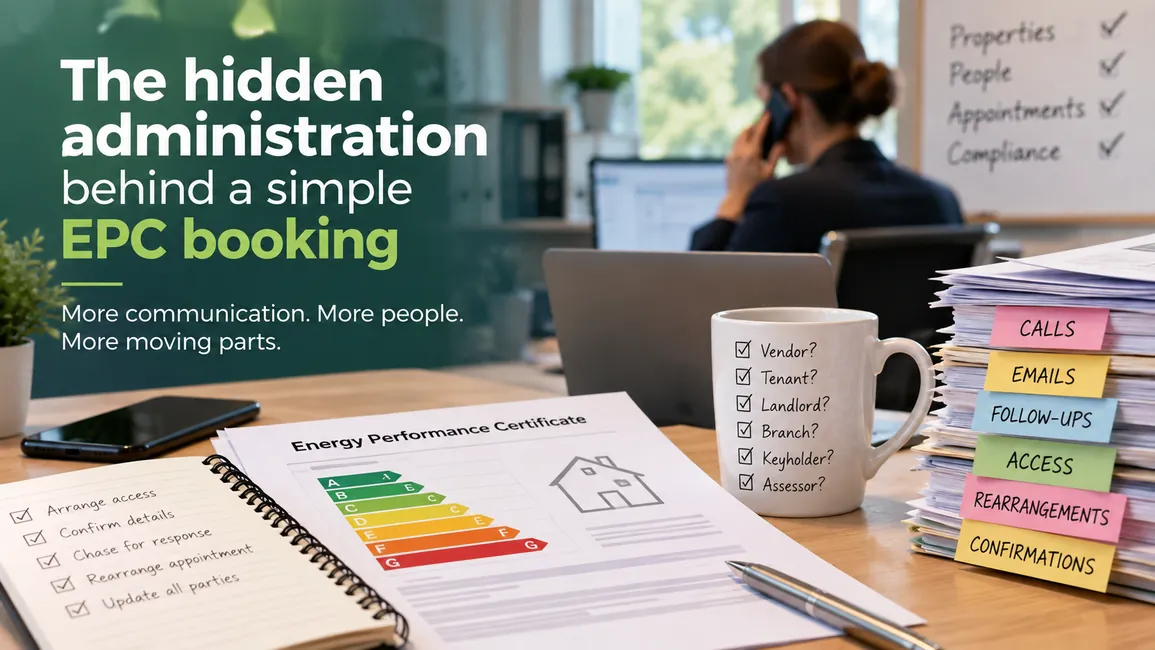
However, the visible instruction often hides a much larger amount of communication behind what appears to be a simple EPC booking. There may be a vendor to contact, a landlord to update, a tenant to coordinate with, a branch team to keep informed and a keyholder who needs to provide access. What appears to be a single booking can quickly develop into a chain of calls, emails, rearrangements and follow-ups.
For estate agents, this hidden administration matters. It takes staff away from other priorities and can make a routine EPC instruction considerably more time-consuming than it first appears.
Why an EPC booking is rarely just one email
The initial instruction is only the starting point. Before the assessment can take place, the EPC provider may need to confirm the property details, establish who can provide access and understand how the EPC appointment should be arranged.
The process will differ depending on whether the property is vacant or occupied, whether keys are held at the branch and whether the vendor, landlord or tenant wants to manage the appointment directly. Commercial properties may also involve an occupier, facilities team, building manager or site security.
Each of these details affects how the booking should be handled. Where the relevant information is available from the beginning, the appointment can often be arranged quickly. Where it is missing or unclear, the EPC provider must begin gathering it before the instruction can move forward.
What happens after the instruction is received
Once the property address has been provided, the first task in the EPC booking process is usually to establish who can grant access. This is not always as straightforward as it sounds, as the contact details supplied may be incomplete, out of date or belong to someone who is not responsible for the booking.
A vendor may not respond immediately, while a landlord may prefer the tenant to arrange the appointment. The tenant may then need to check their availability or coordinate with another occupier before agreeing to a time.
The assessor may also need clarification about the property itself. They may need to confirm whether the instruction relates to a domestic dwelling, a commercial unit or a mixed-use building, and whether the whole property or only one part of it is being assessed.
None of these questions is especially complicated, but every missing detail creates another message and another pause before the EPC appointment can be arranged.
The number of people involved can grow quickly
A booking becomes more complicated as additional parties are added to the communication chain. A domestic instruction may involve the agent, vendor, tenant and assessor, while a commercial property could also include the landlord, occupier, property manager, facilities contact and security team.
Access may need to be agreed with one person but provided by another. The branch might hold the keys, the tenant might need to approve the appointment and the building manager might be the only person able to open a plant room or communal area.
Each additional contact creates another opportunity for a delayed response or misunderstanding. Availability must be coordinated, messages passed on and practical questions directed to the right person. As communication becomes more fragmented, it becomes easier for the booking to stall.
Where the chasing usually begins
The delays behind an EPC booking are rarely caused by one major problem. More often, they consist of unanswered telephone calls, emails waiting for a response and proposed appointment times that are never confirmed.
A contact may respond several days later only to explain that the suggested date is no longer suitable, requiring the assessor to offer a new appointment. A tenant may agree to the visit without informing the landlord, or the branch and owner may each assume that the other is making the arrangements.
Plans can also change at short notice. An occupier may become unavailable, keys may be missing, an incorrect contact may have been supplied or the appointment may need to be rearranged for another reason.
Each issue is manageable on its own. The burden comes from dealing with the same types of issue repeatedly across a number of live EPC instructions.
Why estate agents often become the middleman
Where the EPC provider does not communicate directly with the person responsible for access, the estate agent can end up acting as the link between everyone involved.
The assessor sends available dates to the branch, the branch passes them to the vendor and the vendor asks whether another time is possible. The question then returns to the assessor through the same route, and this exchange may happen several times before the appointment is confirmed.
The agent may also need to relay questions about parking, keys, access restrictions, pets, site procedures or which parts of the property need to be inspected. For a single instruction, the time involved may not appear significant. Across a busy branch or multi-office agency, however, these exchanges create a constant stream of administrative work.
In many cases, the agent has no direct knowledge of the practical issue and is simply passing information between the assessor and the client. Where appropriate, allowing those parties to communicate directly can remove several unnecessary stages.
The hidden administrative cost of EPC bookings
The cost of this chasing is not always obvious because it is spread throughout the working day. A telephone call may only take a few minutes, followed by a short email, a reminder added to a task list and a conversation with a colleague to check whether the client has responded.
Each action is small in isolation, but together they interrupt other work and reduce the time available for progressing sales, lettings and new instructions.
There is also a risk that no one has a complete view of the booking. The agent may know that the instruction has been sent but not whether the occupier has been contacted. The vendor may be waiting for a call, while the assessor believes the branch is still confirming access.
Without clear ownership, the instruction becomes harder to monitor. The real cost of a simple EPC booking is therefore not always the assessment fee itself, but the staff time required to keep the process moving.
Why direct communication makes the process easier
Allowing the EPC provider to speak directly with the vendor, landlord, tenant or occupier removes much of the back-and-forth. The assessor or booking team can offer appointment options, answer practical questions and rearrange visits without asking the agent to relay each message.
This does not mean that the branch loses visibility or control of the instruction. The agent should still know when the relevant contact has been reached, when the assessment is booked and whether there are any issues that require their involvement.
The difference is that the branch no longer needs to manage every practical detail. Direct communication provides a shorter route between the people who need to agree the appointment and gives the client or occupier a clear point of contact for questions about the visit.
Keeping the branch informed without involving it in every detail
A good booking process should reduce the agent’s workload without leaving the branch unsure about progress. The updates provided should focus on the information the agent genuinely needs, such as whether contact has been made, whether the appointment has been confirmed and whether access or evidence issues are likely to cause a delay.
The branch should also be informed if an appointment has failed, further information is required or the expected certificate date has changed. These updates do not need to cover every call, email or attempted contact. They simply need to provide enough information for the agent to understand the status of the instruction and intervene where necessary.
For example, the EPC provider may have made several unsuccessful attempts to contact a tenant. At that stage, the agent may have another route to reach them or may decide to involve the landlord. The value lies in asking for the branch’s support when it is genuinely needed rather than making the team part of every routine exchange.
Managing failed access and rearrangements properly
Not every confirmed EPC appointment results in a completed assessment. The occupier may not be present, keys may not work, access may be refused or parts of the property may be unavailable.
Where this happens, the reason should be recorded clearly and the next action agreed. The provider may need to contact the occupier again, request another set of keys from the branch or obtain permission to enter a plant room, roof area or shared space.
Without a consistent EPC booking process, a failed visit can leave an instruction unresolved. The agent may believe that the assessment is still progressing while the provider is waiting for further guidance.
Clear tracking ensures that the issue is visible, responsibility for the next step is understood and the booking can begin moving forward again.
A better process for repeat instructions
The administrative burden becomes more noticeable when an agency instructs EPCs regularly. At higher volumes, an informal process creates the same points of friction repeatedly.
Different branches may provide different levels of information, contact details may be sent across several emails and progress updates may reach the wrong person. Some instructions may be followed up promptly while others are overlooked.
A standard EPC booking process makes repeat bookings easier to manage. The initial request can include the property address, property type, main contact, access arrangements and any relevant notes. The agency and EPC provider can also agree who should be contacted directly and how progress updates should be shared.
This reduces uncertainty and makes it easier to manage several domestic and commercial instructions at the same time. It also allows missing information and access problems to be identified earlier.
Outsourcing the assessment or outsourcing the whole process
There is an important difference between paying someone to complete an EPC and asking them to take ownership of the instruction.
Where the agent still needs to arrange the appointment, relay every question and chase the certificate, only the technical assessment has been outsourced. Much of the administrative work remains with the branch.
A more complete service manages the instruction from the initial request through to certificate issue. This includes contacting the relevant parties, coordinating access, following up missed appointments and keeping the agent informed at the appropriate stages.
The EPC must still be completed accurately and issued promptly, but much of the wider value lies in removing a routine task from the branch’s workload and making the experience easier for the client.
How EPC GO manages EPC bookings
At R2G, we support estate agents with both domestic and commercial EPC instructions. Where appropriate, we communicate directly with vendors, landlords, tenants and occupiers to arrange access and answer practical questions about the assessment.
We also work with branch teams to ensure they remain informed without needing to manage every telephone call and email. Where access fails or further information is needed, the issue is identified clearly and the next action agreed.
Our aim is not simply to attend the property and produce a certificate. We also help manage the wider EPC booking process.. We manage the steps surrounding the assessment so that the instruction continues to move forward and the branch has less chasing to do.
Behind many apparently simple EPC bookings is a considerable amount of communication. A well-managed service ensures that the estate agent does not have to handle all of it.
FAQs
What administration is involved in arranging an EPC?
The process may include identifying the correct contact, agreeing an appointment, arranging keys, confirming access requirements, answering questions and following up missed or rearranged visits.
Why do estate agents spend time chasing EPC bookings?
Agents can become the communication link between the assessor, vendor, landlord and tenant. Where every message passes through the branch, even a straightforward booking can require several calls and emails.
Can an EPC provider arrange access on behalf of an estate agent?
Yes. A provider can contact the relevant owner, landlord, tenant or occupier directly where this has been agreed, while keeping the branch updated at important stages.
How should a failed EPC appointment be handled?
The reason for the failed visit should be recorded clearly and the next action agreed. This may involve contacting the occupier again, arranging new keys or obtaining permission to access a restricted area.
What is the difference between outsourcing an EPC and outsourcing the booking process?
Outsourcing the EPC only covers the technical assessment. A fuller service also takes responsibility for contacting the relevant parties, arranging access, managing rearrangements and keeping the agent informed.