EPC guides
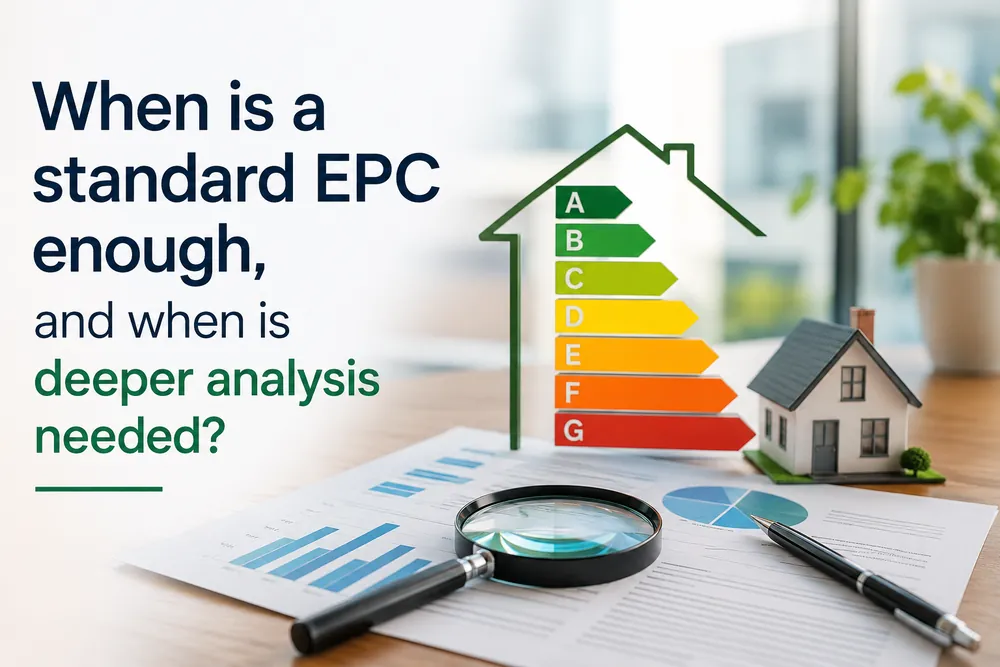
When is a standard EPC enough, and when is deeper analysis needed?
An EPC can be a useful and proportionate tool. It gives a property an energy rating, records key information about the building and provides recommendations that may improve its performance. In many cases, that is exactly what the client needs.
Where the aim is simply to obtain a valid certificate for a sale, letting or straightforward rating check, a standard EPC may be sufficient. The difficulty arises when the certificate is expected to answer questions it was not designed to address.
An EPC assesses the building and its systems through a standardised methodology. It does not fully capture how the property is used in practice, how effectively its systems are controlled or whether the people occupying it are operating it efficiently. This distinction becomes important when clients are making decisions about cost, compliance, improvement works or long-term investment, where EPC analysis may provide useful additional insight.
When a standard EPC does the job
A standard EPC is often sufficient where the requirement is clear and limited. The property may need a current certificate for marketing, sale or letting, or the owner may simply want to confirm the existing rating or replace an expired assessment.
Where the building is relatively straightforward and no wider decision depends on the outcome, an EPC can provide the necessary information without adding unnecessary complexity. Not every property requires a detailed energy study, and there is little value in commissioning extensive analysis when the only requirement is a reliable certificate completed properly and on time.
The key is to understand what the EPC is being asked to achieve and whether EPC analysis is needed beyond the certificate itself. If the question is simply, “What is the current rating?”, the certificate may answer it well. If the client needs to know what they should spend money on, what it is likely to cost and how the work can be delivered, the EPC alone is unlikely to provide enough detail.
What an EPC can and cannot tell you
An EPC provides a modelled view of the building. Depending on the type of property, it considers features such as construction, insulation, glazing, heating, cooling, ventilation and lighting. This creates a consistent basis for assessing and comparing buildings.
It does not, however, provide a complete picture of actual energy performance. The calculation is not primarily based on the behaviour of occupants, the precise way controls are used or how well systems are maintained from day to day.
A building can therefore achieve a relatively good EPC rating while still consuming more energy than expected. Equally, a lower-rated building may be operated carefully and perform better in practice than the certificate alone would suggest.
The EPC remains useful, but it represents only one part of the overall picture, and EPC analysis may be needed where a fuller understanding of the building is required.
Why building use can change the picture
The way a building is used can have a significant effect on its actual energy consumption. Operating hours may be longer than assumed, heating and cooling systems may run at the same time, controls may be poorly set and empty areas may continue to be heated, lit or ventilated.
Occupancy patterns also matter. A school, office, warehouse, shop and residential property can all contain efficient equipment while using it in very different ways. Even the same building may perform differently under two occupiers because of variations in working hours, comfort expectations, equipment loads and day-to-day management.
Maintenance can influence performance as well. A heating system may be efficient in principle but poorly commissioned, while sensors may be faulty or timers may no longer reflect how the property is occupied.
These issues are not always visible within the EPC rating. Where the client is trying to reduce energy costs or understand why consumption is high, reviewing how the building is operated may be more useful than looking at the certificate alone.
When deeper analysis becomes valuable
Further EPC analysis is usually worthwhile where the client needs to make a more significant decision. This may be because the EPC rating creates a potential compliance concern, improvement works are being considered or the property has unusually high energy costs.
It may also be valuable where the building is technically complex, several measures are being compared or the owner needs to understand how much improvement can realistically be achieved.
A standard EPC may suggest a range of possible actions. Deeper analysis should help determine which of those actions are worth pursuing by testing likely rating changes, considering the cost implications and assessing whether the work is practical within the building.
This moves the conversation beyond what could be done and towards what should be prioritised, why it is worthwhile and how it might be delivered.
Understanding cost, value and deliverability
Generic recommendations can highlight potential opportunities, but property firms usually need more detail before committing budget. They need to understand the likely cost, expected benefit and practical implications of carrying out the work.
A measure may improve the modelled EPC rating while offering limited financial value. Another may provide a stronger return but require significant disruption, access or enabling works. There may also be a difference between the measure that produces the quickest rating improvement and the one that best supports the long-term performance of the property.
EPC analysis can help compare these trade-offs and identify where further evidence, design work or contractor input is needed before a reliable decision can be made.
The purpose is not to produce a larger report for its own sake. It is to give the client enough clarity to justify the investment and understand what delivery will involve.
How recommendations fit into the wider building
Building improvements rarely take place in isolation. A heating upgrade may affect controls, ventilation or electrical capacity, while insulation work may need to align with roof replacement, external repairs or internal refurbishment.
The tenant or occupier may control part of the system, and the lease may determine who is responsible for the work. Access may only be practical at certain times, while planned maintenance may create a better opportunity to complete the improvement.
A measure that appears expensive as a standalone project may become more cost-effective when it is combined with work that is already planned. This wider context can make a significant difference to whether a recommendation is practical and worthwhile.
Useful advice should therefore consider how the proposed change interacts with the building, the people using it and the work taking place around it. Without that context, the client may receive technically valid recommendations that are difficult to implement.
Avoiding the two extremes
There are two unhelpful extremes. The first is assuming that every property requires a detailed technical study, which can add cost and delay to a straightforward requirement without creating much additional value.
The second is assuming that an EPC can answer every question about energy use, compliance and future investment. This can leave important gaps around cost, behaviour, operation and delivery.
The right approach lies between the two. A standard EPC should be used where it provides enough information, while deeper analysis should be introduced where the decision requires greater confidence.
The level of work should reflect both the complexity of the property and the consequences of the decision being made.
Choosing the right level of analysis
A useful starting point is to consider what the client needs to know at the end of the process.
Where they need a valid certificate and confirmation of the current rating, a standard EPC may be sufficient. If they need to understand compliance risk, compare improvement routes or prepare a budget, additional analysis will probably be required.
Where the focus is on actual energy performance, the assessment should also consider how the building is operated and used. This may involve reviewing consumption data, speaking to occupants, examining controls or understanding the wider maintenance and investment plan.
Any deeper analysis should remain proportionate. Its purpose is not to replace the EPC, but to build on it where the certificate leaves important questions unanswered.
How R2G supports both
At R2G, we provide domestic and commercial EPCs where a straightforward certificate is the appropriate level of support. We also recognise when the rating is only the beginning of a wider conversation.
Where clients need greater clarity, we can look beyond the certificate and help assess costs, priorities, delivery constraints and the way the building is actually used. This may involve reviewing improvement options, testing likely outcomes or linking recommendations with wider maintenance, tenant and investment plans.
The aim is to provide the right level of EPC analysis for the decision being made. Sometimes a standard EPC provides everything the client needs. In other cases, the most important questions concern what the certificate does not show.
FAQs
When is a standard EPC sufficient?
A standard EPC is often enough where the client needs a valid certificate, a current energy rating or a straightforward assessment for sale, marketing or letting.
What information does an EPC provide?
An EPC provides a modelled energy rating based on the property’s construction, insulation and relevant building systems. It also includes standard recommendations that may improve the rating.
Does an EPC show actual energy consumption?
Not fully. An EPC uses a standardised methodology and does not capture every aspect of occupant behaviour, operating hours, system control or day-to-day maintenance.
When is deeper energy analysis needed?
Further analysis may be useful where the client needs to understand compliance risk, compare improvement options, prepare a budget, reduce actual energy use or make a significant investment decision.
What can deeper analysis include?
It may include reviewing energy consumption, assessing controls, modelling improvement options, considering costs and examining how proposed work fits with maintenance, leases and operational requirements.
Does deeper analysis replace the EPC?
No. It usually builds on the EPC where the certificate alone does not answer the client’s wider questions.